Automated findings stop at possibility
Scanners can identify known weaknesses, but they rarely show whether those weaknesses can be combined, exploited, or used to reach something important.
See how an attacker can reach what matters before they do.
Choose the assessment that matches the risk
CulperSec penetration testing uses authorized adversarial techniques to show which weaknesses are genuinely exploitable, how attack paths develop, and what those paths mean for the systems and data your organization depends on.
Scanners can identify known weaknesses, but they rarely show whether those weaknesses can be combined, exploited, or used to reach something important.
Real intrusions move between applications, identities, networks, wireless access, people, and physical controls instead of remaining inside one tool category.
A control can exist on paper while implementation gaps, business logic, trusted relationships, or human behavior still create a practical route to compromise.
Each engagement is scoped independently, but every assessment receives the same emphasis on manual validation, realistic attacker behavior, operational safety, and practical remediation.
Test what an attacker could accomplish after gaining an internal foothold, including discovery, credential access, lateral movement, privilege escalation, and access to sensitive systems.
Assume the perimeter was crossed
Evaluate internet-facing systems and services using attacker techniques to identify exploitable exposure, weak configuration, and paths into the organization.
Test the public attack surface
Assess authentication, authorization, session handling, input processing, business logic, data exposure, and application-specific abuse that automated scans often miss.
Go beyond vulnerability scans
Review wireless configuration, encryption, segmentation, authentication, and nearby attack opportunities to determine whether wireless access creates a route into trusted systems.
Validate wireless boundaries
Use authorized phishing, smishing, vishing, cloned-voice, or physical scenarios to evaluate how people and processes respond to realistic manipulation attempts.
Test human and process controls
Combine technical, human, and physical attack methods in a goal-driven engagement designed to test prevention, detection, escalation, and response across the organization.
Exercise the complete defense
A strong engagement combines adversarial creativity with explicit authorization, safety controls, and communication. Both teams know what is permitted, when to escalate, and how findings will be handled.
CulperSec assessment team
We own the methodology, controlled execution, evidence quality, finding validation, and clarity of the final assessment record.
Translate the authorized scope and objectives into a test plan with appropriate techniques, evidence standards, safety controls, and escalation paths.
Use manual and automated techniques to identify and validate attack paths while respecting agreed boundaries and operational constraints.
Confirm exploitability, remove false positives, document evidence, and explain how technical weaknesses affect real systems, data, and business operations.
Provide technical findings, executive context, positive observations, remediation guidance, and an organized workspace for ongoing review.
Your project and security teams
You provide authorization, operational context, access coordination, and the internal ownership needed to turn results into safer systems.
Identify the systems, applications, networks, people, facilities, or outcomes in scope and provide written authorization for the agreed testing activity.
Document prohibited actions, maintenance constraints, sensitive systems, emergency contacts, and conditions that require testing to pause or escalate.
Coordinate credentials, test accounts, allowlisting, technical contacts, architecture details, and business context appropriate to the assessment model.
Prioritize corrective work, assign responsible owners, accept risk where appropriate, and coordinate changes through internal governance and change control.
The methodology adapts to the assessment type while preserving a consistent process for scope control, safe execution, evidence, risk interpretation, and delivery.
Define objectives, assets, testing perspective, rules of engagement, safety constraints, communication paths, and success criteria.
Gather intelligence, map the environment, understand exposed services and trust relationships, and identify likely attack paths.
Use authorized attacker techniques to exploit weaknesses, chain findings, test controls, and pursue the agreed engagement objectives.
Confirm each finding, capture reproducible evidence, assess likely impact, remove false positives, and preserve a clear activity record.
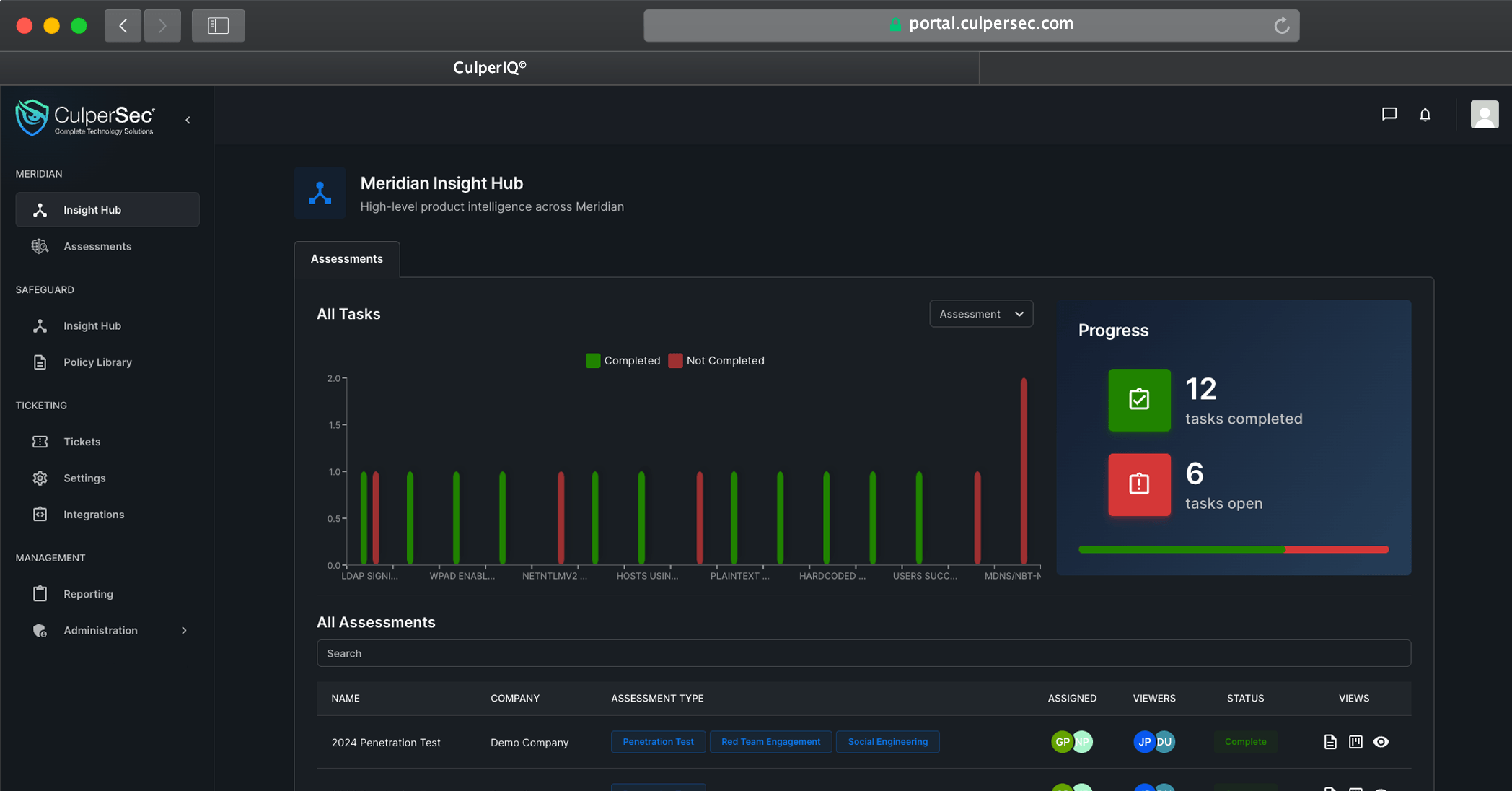
Review technical and executive results, provide prioritized remediation guidance, and keep findings active in Meridian Assessments after delivery.
Every CulperSec penetration test includes one year of Meridian Assessments access so findings, ownership, remediation progress, and updated reporting remain available after delivery.
The engagement delivers more than a vulnerability list. Teams receive validated attack evidence, practical remediation context, and an organized record they can use to improve security after testing ends.
Tell us what needs to be tested, what outcome matters, and which operational boundaries we need to respect. We will help shape the right engagement.